
Published August 31, 2026
Empty Kilometers in Trucking: How They Affect Your Real Transport Cost
Empty kilometers generate no transport revenue, but they still consume fuel, driver time and vehicle capacity. Learn how to measure their real impact and make better pricing and planning decisions.
Empty Kilometers in Trucking: How They Affect Your Real Transport Cost
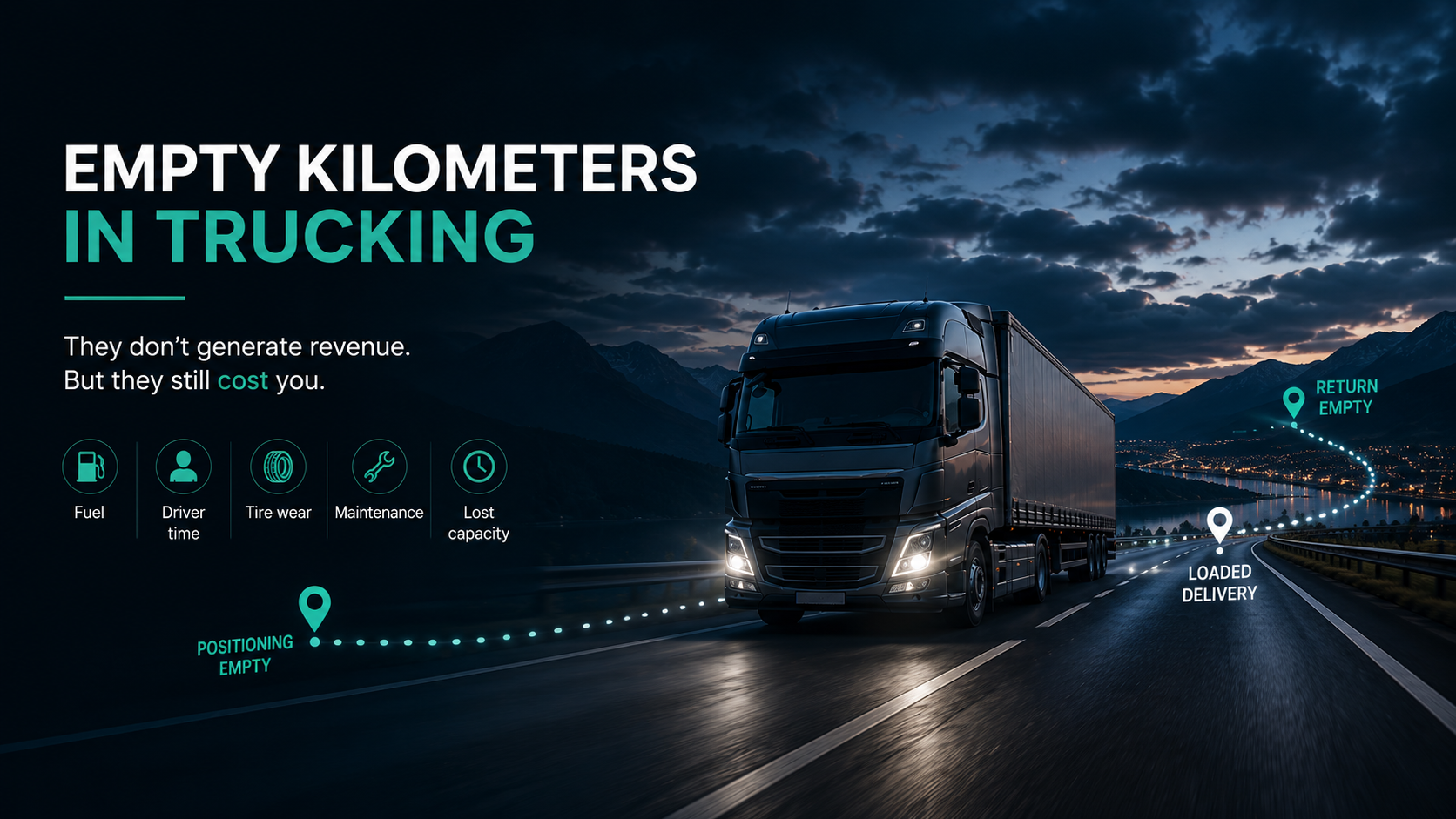
A truck doesn't stop costing money just because the trailer is empty.
Fuel is still being consumed. Tires are still wearing. The driver is still working. Maintenance intervals are getting closer, and valuable vehicle capacity is being used.
But there is one major difference:
Those kilometers are not directly generating transport revenue.
This is why empty kilometers can have a much bigger impact on transport profitability than their share of total distance might suggest.
Understanding that impact starts with looking beyond the rate you receive for the loaded part of a transport.
Loaded kilometers don't tell the whole story
Imagine a customer asks for a transport covering 500 loaded kilometers.
You calculate your costs, submit a rate and complete the job.
From the customer's perspective, it may look like a 500-kilometer transport.
But what if your truck has to travel 100 kilometers empty before reaching the loading point?
Your operation didn't cover 500 kilometers.
It covered:
100 km empty + 500 km loaded = 600 total km
The truck creates operating costs across all 600 kilometers.
If your pricing calculation considers only the loaded distance, part of the real cost of performing that transport can easily disappear from the calculation.
What does an empty kilometer actually cost?
An empty truck usually consumes less fuel than the same vehicle at a high gross weight.
But that does not make the empty kilometer free.
During an empty movement, you may still incur:
- fuel consumption
- driver cost
- tire wear
- maintenance-related cost
- depreciation
- financing and other allocated fixed costs
- tolls and road charges where applicable
- consumption of available vehicle capacity
- consumption of available driver working and driving time
Some of these costs vary directly with distance.
Others exist regardless of whether the vehicle is loaded.
The exact cost will therefore depend on the vehicle, route, operating conditions and the company's own cost structure.
This is why applying one generic industry figure to every truck is rarely the best approach.
Your real cost per loaded kilometer can be much higher than your cost per total kilometer
This distinction is particularly important when setting transport rates.
Consider a simplified example.
Assume your real operating cost is:
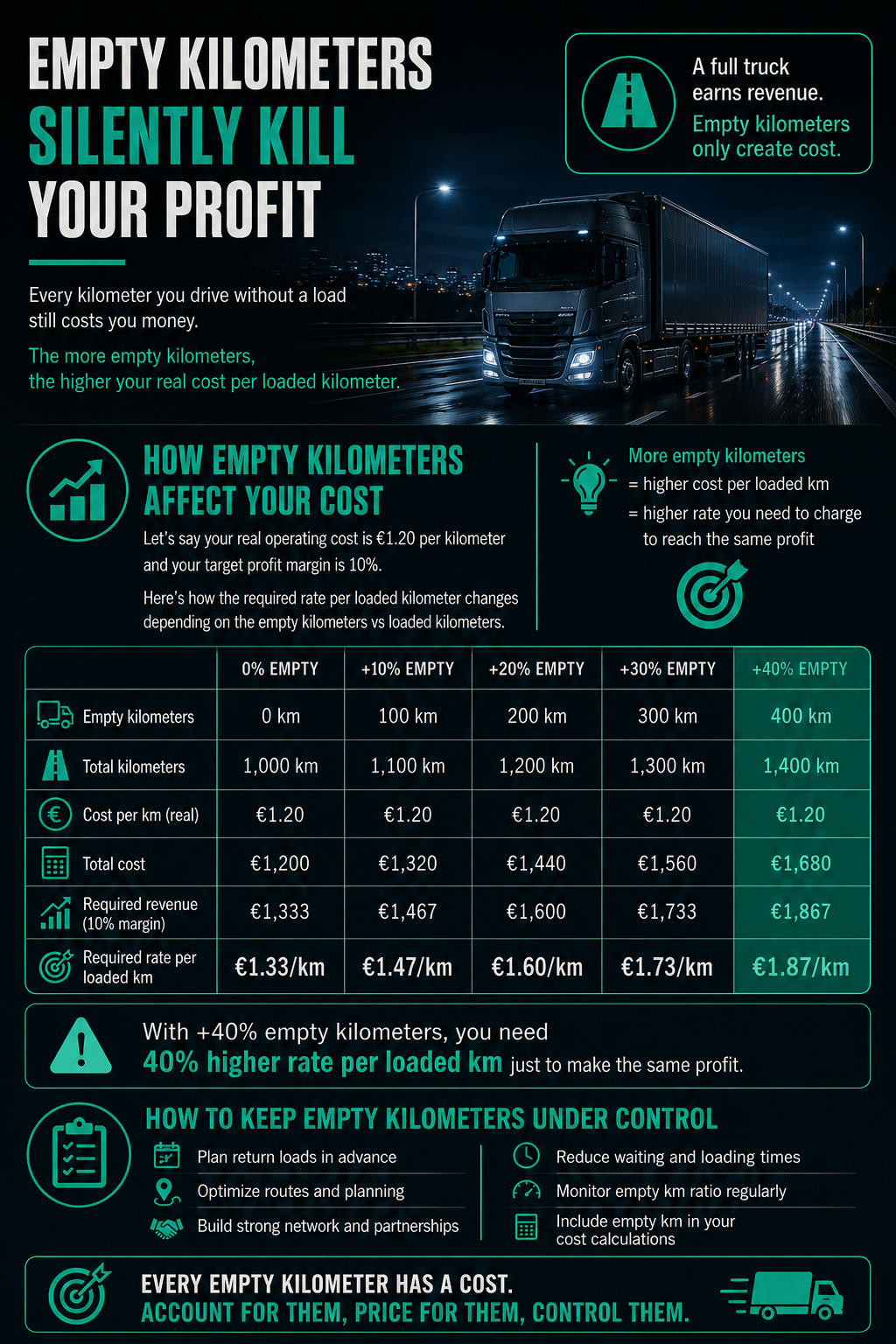
€1.20 per total kilometer
You receive a transport requiring:
500 loaded km
If there are no additional positioning kilometers:
500 × €1.20 = €600 operating cost
The cost attributable to each loaded kilometer is therefore:
€600 / 500 = €1.20 per loaded km
Now assume the same 500-kilometer transport requires 100 empty kilometers.
Total vehicle movement becomes:
600 km
At the same simplified €1.20/km assumption:
600 × €1.20 = €720
But you still have only 500 loaded kilometers over which the transport earns its freight revenue.
That means:
€720 / 500 = €1.44 real cost per loaded km
Nothing changed about the customer's 500-kilometer shipment.
What changed was the operation required to perform it.
That difference matters when deciding whether the offered freight rate is actually attractive.
Empty kilometers can happen before and after the load
It is easy to think only about the empty distance before loading.
But the complete transport cycle can include several non-revenue movements.
For example:
Truck base → Loading point
The vehicle may need to position empty before collecting the shipment.
Loading point → Delivery point
This is the main loaded movement.
Delivery point → Next loading point
Another empty movement may be required to reach the next customer.
Final delivery → Truck base
Depending on the operation, the vehicle may eventually need to return to its base or another planned location.
Looking at only one transport order can therefore hide costs that become obvious when the entire vehicle cycle is considered.
A high freight rate can still produce a poor result
Suppose you have two possible jobs.
Job A offers a higher rate per loaded kilometer.
Job B offers a slightly lower rate.
It may seem obvious that Job A is the better choice.
But imagine Job A requires a long empty positioning movement and leaves the truck in a location where finding the next load is difficult.
Job B starts close to the truck's current location and finishes in an area where you regularly have return freight available.
Suddenly, comparing only the two loaded rates tells you very little.
The better question is:
What happens to the truck before, during and after each job?
This is where transport planning and transport costing become closely connected.
A commercially attractive load should ideally work within the wider vehicle cycle, not only look good as an isolated order.
Return loads can completely change the calculation
Return-load opportunities are one of the most important factors when evaluating a transport lane.
Consider a regular route between Point A and Point B.
If demand exists in both directions, the vehicle may generate revenue across a much larger share of its total mileage.
If freight exists only from A to B, the return journey becomes a different problem.
You may:
- find another customer for the return direction
- reposition the vehicle to another loading area
- accept a lower-paying return load
- return empty
- redesign the vehicle's wider route
Each option has a different economic result.
This is why a low-paying return load should not automatically be rejected.
If the alternative is a long empty movement, a lower rate may still contribute positively to the overall vehicle cycle.
But the same logic has limits.
A load should not be accepted simply because it is better than driving empty.
You still need to understand the additional costs, time, route implications and effect on the next available transport opportunity.
Don't eliminate empty kilometers at any price
A target of zero empty kilometers sounds ideal.
In practice, it may not always be economically sensible or operationally possible.
Imagine a truck has completed a delivery and you have two options.
The first is to drive a moderate distance empty to a strong loading area where a profitable shipment is available.
The second is to accept a poorly priced shipment nearby simply to avoid recording empty kilometers.
If the second option consumes more time, places the truck in the wrong location or prevents a better transport later, your empty-kilometer KPI may improve while the business result gets worse.
This is an important distinction:
The objective is not necessarily to minimize empty kilometers at any cost.
The objective is to optimize the overall operation.
Empty kilometers are a cost to manage, not a KPI that should override every other commercial consideration.
Empty-kilometer percentage is useful, but it needs context
A simple fleet KPI can be calculated as:
Empty kilometer percentage = Empty kilometers / Total kilometers × 100
If a truck covers:
10,000 total km
of which:
1,500 km are empty
then:
1,500 / 10,000 × 100 = 15% empty kilometers
Tracking this over time can be useful.
You can compare:
- individual vehicles
- routes
- customers
- operating regions
- dispatch strategies
- months or seasons
But the percentage should not be interpreted without context.
A vehicle operating a difficult network may naturally have a different empty-kilometer profile from one operating a stable round-trip route.
The purpose of the KPI is to identify opportunities and understand performance, not to automatically conclude that the vehicle with the lowest percentage is always performing best.
Look at empty kilometers by customer
This is where the analysis becomes particularly useful.
Suppose Customer A generates significantly more annual revenue than Customer B.
At first glance, Customer A may appear to be your more valuable customer.
But what if serving Customer A regularly requires substantial empty positioning?
Customer B may offer:
- better vehicle positioning
- more predictable routes
- easier return-load opportunities
- less waiting
- more efficient use of available capacity
Revenue alone won't show that difference.
Allocating empty kilometers to customers or transport flows can give you a much better understanding of customer profitability.
This does not mean every empty kilometer must be assigned perfectly to one customer.
Transport networks are interconnected.
But even a consistent allocation methodology can reveal patterns that revenue reports alone cannot show.
Look at empty kilometers by route
Regular lanes deserve particular attention.
If a vehicle repeatedly travels empty over the same section of its operation, that is no longer a random event.
It is a structural characteristic of the transport flow.
That gives you something you can work with.
You might investigate whether it makes sense to:
- find a regular return customer
- cooperate with another carrier
- change vehicle positioning
- redesign dispatch planning
- adjust the transport rate
- reconsider where the vehicle is based
- combine the route with another transport flow
Sometimes the solution isn't finding another load.
Sometimes the correct response is simply recognizing that the empty movement is unavoidable and pricing the main transport accordingly.
Where you base a truck can matter
Vehicle location is another factor that can create unnecessary empty mileage.
Imagine a company regularly moves its own goods between two factories.
The loaded transport flow is predictable.
Depending on where the truck is based, one setup may allow the vehicle to start close to the regular loading point.
Another setup may require the truck to perform an additional empty movement before productive work begins.
If management looks only at one isolated cost — driver compensation, parking cost or another local KPI — it can miss the much larger cost created elsewhere in the operation.
The correct comparison is therefore not:
Which individual cost is lower?
It is:
Which setup produces the better total operating result?
This principle extends far beyond empty kilometers.
Optimizing one cost center can sometimes increase the total cost of the business.
Empty kilometers also consume time
Distance is only part of the problem.
An empty movement consumes time that cannot simultaneously be used for another transport.
For drivers operating under regulated driving and working-time regimes, that time can also affect what is legally and practically possible later in the shift or transport cycle.
The applicable rules differ by jurisdiction and operation, so transport planning must always follow the relevant legal requirements.
From an economic perspective, however, the principle is universal:
Vehicle and driver capacity are limited resources.
An empty movement uses part of that capacity without directly generating freight revenue.
This is why two operations with the same empty-kilometer percentage can still produce different economic results if the empty movements consume different amounts of valuable time or occur in different parts of the transport network.
Pricing should reflect the transport you actually have to perform
A common mistake is to calculate a rate from the customer-visible distance alone.
If performing a 500 km shipment consistently requires another 100 km of positioning, those kilometers are part of the economics of serving that transport.
That does not necessarily mean showing the customer a separate line called "empty kilometers."
Commercial pricing can be structured in many ways.
But internally, you should know they exist.
Your rate needs to recover the cost of the operation you actually perform, not an idealized version of it.
This becomes even more important when quoting regular transport lanes.
If historical data shows that a route consistently creates empty positioning, that information should influence future pricing and planning decisions.
Measure first, then improve
You cannot manage empty kilometers effectively if you do not know where they occur.
A useful starting point is to track:
- total kilometers
- loaded kilometers
- empty kilometers
- empty-kilometer percentage
- empty positioning before loading
- empty movement after delivery
- routes with recurring empty mileage
- customers associated with significant positioning
- available return-load opportunities
Over time, patterns become visible.
Maybe one customer consistently creates difficult vehicle positioning.
Maybe one region produces good outbound freight but poor return opportunities.
Maybe dispatch decisions are creating unnecessary repositioning.
Or perhaps a certain amount of empty mileage is simply an unavoidable part of a profitable operating model.
All of those conclusions are useful.
The goal is not to make the dashboard show zero.
The goal is to understand why the empty kilometers exist and whether they make economic sense.
Empty kilometers should influence decisions, not control them
Empty mileage is one of the clearest examples of why transport management cannot be reduced to a single KPI.
Reducing empty kilometers can:
- lower operating costs
- improve vehicle utilization
- reduce unnecessary fuel consumption
- release driver and vehicle capacity
- improve profitability
But eliminating them blindly can create other problems.
The best transport decision considers the entire operation:
cost + revenue + time + positioning + capacity + the next transport opportunity
That is why the question should not simply be:
"How do we eliminate empty kilometers?"
A better question is:
"Which empty kilometers are avoidable, which are economically justified, and are we pricing the unavoidable ones correctly?"
That question leads to much better decisions.
Calculate the full operation with Effitrux
Effitrux is designed to help transport companies calculate a transport based on the operation that actually needs to be performed.
Instead of looking only at the customer's loaded distance, transport calculations can account for the additional distance and costs involved in completing the job.
That allows you to evaluate the transport from the perspective of its real operating cost, apply your target profit margin and determine whether the resulting selling price makes commercial sense.
Because an empty kilometer may not appear on the customer's transport order.
But it still appears in your costs.
Calculate your transport cost with Effitrux
This article is provided for general informational purposes only and does not constitute financial, legal or operational advice. Transport costs and regulatory requirements vary by business, vehicle, route, operating model and jurisdiction. Examples are illustrative and should be replaced with data applicable to your own operation.