
Published August 26, 2026
How to Calculate the Real Cost of a Truck Transport Job
A practical guide to understanding the costs behind every transport job, making better use of fleet data and setting prices that reflect the profitability you actually want to achieve.

Knowing how much a transport job costs sounds simple.
Calculate the fuel, add the driver cost and tolls, put a margin on top and you have your price.
In reality, transport costing is rarely that simple.
A truck generates costs when it is moving, when it is waiting and, in many cases, even when it is parked. Some costs are directly connected to a particular trip. Others exist every month and need to be distributed across the work the vehicle performs.
Then there are empty kilometers, maintenance, financing costs, administration and other expenses that are easy to overlook.
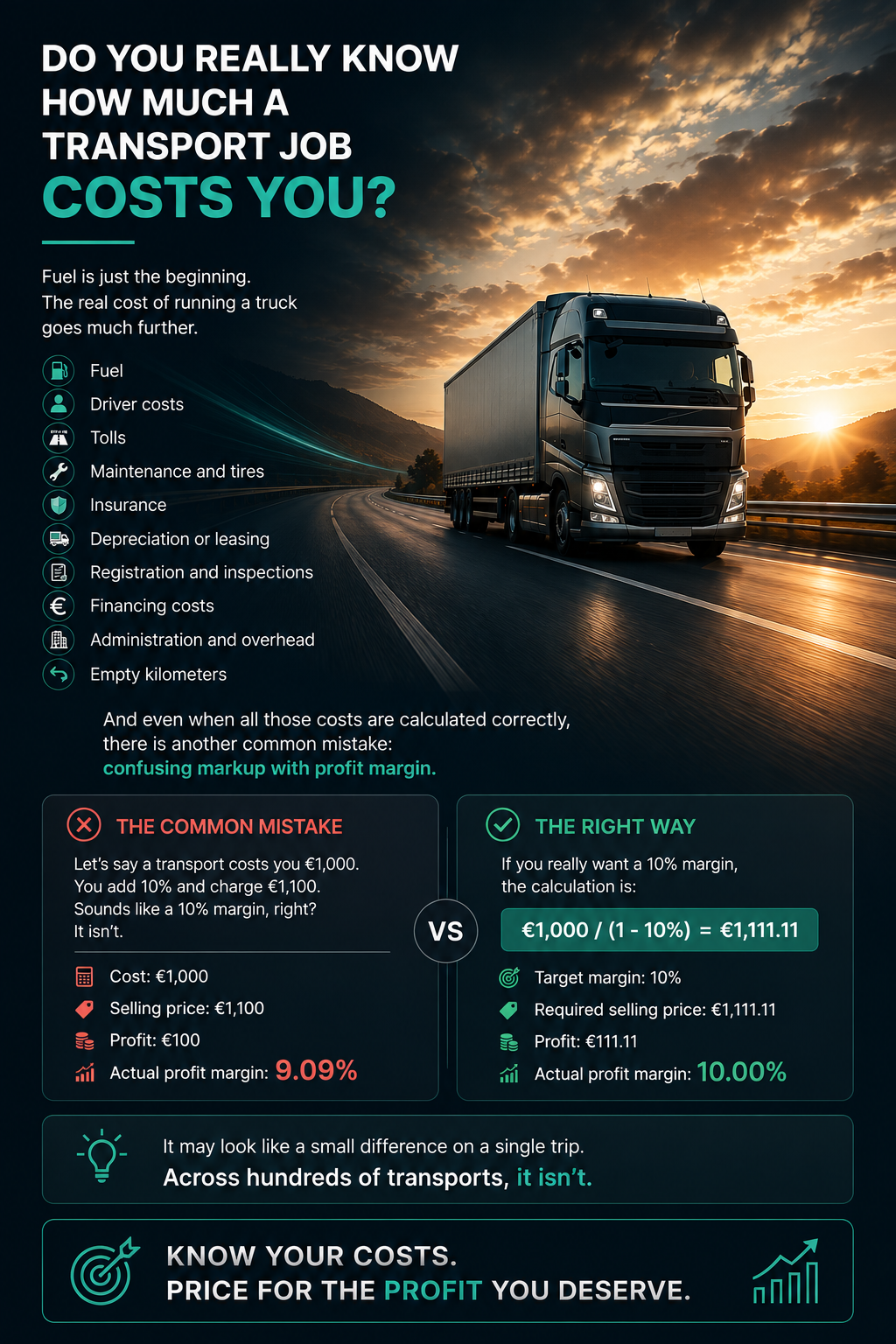
And even when all of those costs are calculated correctly, there is another common pricing mistake: confusing markup with profit margin.
A transport rate can look profitable while delivering a smaller margin than expected.
So, what should you consider when calculating the real cost of a transport job?
Start with the costs that change when the truck moves
Some transport costs are directly related to vehicle operation and can be attributed relatively easily to a particular trip.
Fuel
Fuel is one of the most visible operating costs, but it should be calculated using realistic consumption rather than an ideal figure.
If a truck consumes 30 litres per 100 km and the route is 600 km, the basic calculation is:
600 km × 30 L / 100 km = 180 litres
The fuel cost then depends on the applicable fuel price.
But even this simple calculation has limitations.
Vehicle weight, road profile, traffic, weather, driving style and other operating conditions can all affect actual consumption.
A truck carrying a heavy load through mountainous terrain will not necessarily consume the same amount of fuel as the same vehicle carrying a lighter load on a flat motorway.
For regular operations, comparing estimated consumption with actual historical consumption can therefore provide a much better basis for costing.
Your own fleet data is usually more useful than a generic assumption if you have enough reliable data available.
Tolls and road charges
Tolls can represent a significant part of the cost of road transport, particularly on international routes.
They should not simply disappear inside an estimated cost per kilometer when the actual route and applicable road charges are known.
Depending on the country and road network, charges may depend on factors such as:
distance travelled
vehicle category
number of axles
maximum permissible weight
emissions or CO₂ class
road or infrastructure category
For a quotation, the expected toll cost should therefore reflect the actual planned route as closely as reasonably possible.
This becomes particularly important when comparing alternative routes.
A shorter route is not automatically the cheaper route if its toll structure is substantially more expensive.
Driver costs
Driver cost is more than the amount paid for driving time.
Depending on the employment model, country and applicable legislation, the real employer cost may include salary, employer contributions, allowances, bonuses and other employment-related costs.
Time matters as well.
Two transport jobs covering the same distance may require very different amounts of driver time.
One may involve efficient loading and unloading with minimal waiting.
Another may involve several hours at a loading dock before the truck can continue.
The distance can be identical while the operational cost and amount of available driver and vehicle capacity consumed by the job are very different.
This is one reason why distance alone cannot fully describe the cost of a transport operation.
Transport planning must also respect all applicable rules governing driving time, working time, breaks and rest periods in the jurisdictions where the operation takes place.
A transport plan that depends on unrealistic or non-compliant driving and working schedules is not a valid cost calculation.
Maintenance and tires belong in the calculation too
Maintenance is easy to underestimate because the expense does not occur evenly.
A truck may operate for weeks without a significant repair and then suddenly require an expensive intervention.
The same applies to tires.
If these costs are considered only when the invoice arrives, individual months or individual transport jobs can give a misleading picture of profitability.
A transport costing model can instead allocate an expected maintenance and tire cost across vehicle operation.
Historical fleet data is particularly useful here.
If you know how much a particular vehicle or vehicle category has actually cost to maintain over a meaningful period, you can build a more realistic cost assumption than relying entirely on a generic industry average.
Preventive maintenance also matters.
Maintenance should not be viewed only as a cost to minimize. Poor maintenance can eventually create additional downtime, unplanned repairs and lost transport capacity.
Don't forget the costs that exist even when the truck isn't moving
This is where transport costing becomes more interesting.
Not every cost disappears when you turn off the engine.
A vehicle may still carry costs such as:
depreciation or leasing
insurance
registration and inspections
financing
administration and overhead
licences and fleet systems
certain employment-related costs
other fixed or semi-fixed operating expenses
These costs need to be recovered through the productive work performed by the vehicle.
That creates an important relationship between vehicle utilization and cost per kilometer.
Imagine, purely as an illustrative example, that a truck has €4,000 of relevant fixed costs per month.
If it covers 8,000 km:
€4,000 / 8,000 km = €0.50/km
At 10,000 km:
€4,000 / 10,000 km = €0.40/km
At 12,000 km:
€4,000 / 12,000 km = €0.33/km
The €4,000 monthly fixed cost hasn't changed.
What changed is the number of kilometers across which that cost was distributed.
But this does not mean that the goal should simply be to maximize kilometers.
More kilometers are useful only when the economics behind those kilometers make sense.
Empty kilometers are not free kilometers
A truck travelling empty still consumes resources.
It uses fuel.
The driver is still consuming working time.
The tires are still wearing.
The vehicle is still accumulating mileage.
Maintenance intervals are getting closer.
And vehicle capacity that could potentially be used for revenue-generating work is being consumed.
Suppose a customer requires a 500 km loaded movement, but positioning the vehicle for that job requires another 100 km without a load.
The customer may see a 500 km transport.
Your operation has to account for 600 km of vehicle movement.
That distinction becomes particularly important when comparing transport rates.
A higher rate on one lane may actually produce a worse overall result if the job requires substantial empty positioning.
Conversely, a slightly lower rate may be more attractive if it fits efficiently into the rest of the transport network and creates a good opportunity for the next load.
This is why looking only at revenue per loaded kilometer can sometimes be misleading.
The truck doesn't know whether a kilometer is loaded or empty.
It creates costs either way.
Waiting time has a cost too
Consider two transport jobs covering exactly the same distance.
The first has predictable loading and unloading.
The second leaves the vehicle waiting at a loading dock for several hours.
The second job may not consume much additional fuel while the truck is stationary, but the vehicle and driver are still unavailable for other work.
That lost capacity has economic value.
Waiting can also affect subsequent transport planning and, depending on the circumstances and applicable rules, the driver's remaining available working and driving time.
A delay on one transport can therefore affect more than that transport alone.
It may also affect the next planned job.
This is why a good transport calculation shouldn't look only at distance.
Time and capacity matter too.
Calculate the expected real cost of the transport
Once the relevant cost categories have been identified, they can be combined into an expected cost of performing the transport.
Conceptually, this may include:
Variable vehicle costs
Driver-related costs
Tolls and route-specific charges
Allocated fixed costs
Empty positioning costs
Other job-specific costs
=
Estimated real transport cost
Exactly which categories should be included and how they should be allocated depends on the operation.
There is no universal cost-per-kilometer figure that applies to every trucking company.
The important point is consistency.
If a cost exists because you operate the transport business, it eventually has to be recovered somewhere.
Ignoring it does not make it disappear.
Cost is not the same as price
Once you know the expected cost of a transport, you still haven't calculated the selling price.
Suppose your calculation shows that a transport job will cost:
€1,000
You want a 10% profit margin.
A common calculation is:
€1,000 + 10% = €1,100
It sounds reasonable.
But it doesn't produce a 10% profit margin.
At a selling price of €1,100:
Revenue: €1,100
Cost: €1,000
Profit: €100
Profit margin is calculated against revenue:
€100 / €1,100 = 9.09%
You added a 10% markup on cost, but achieved a 9.09% profit margin.
Those are two different concepts.
Markup and profit margin are not the same thing
Markup measures profit relative to cost.
Profit margin measures profit relative to selling price.
Using the same example:
Cost: €1,000
Selling price: €1,100
Profit: €100
Markup:
€100 / €1,000 = 10%
Profit margin:
€100 / €1,100 = 9.09%
Both numbers are correct.
They simply measure different things.
This distinction becomes increasingly important as the target percentage becomes larger.
If your pricing strategy is based on a target profit margin, simply adding that percentage to the transport cost will not produce the margin you intended.
How to calculate a true target profit margin
If your target is a genuine 10% profit margin, the selling price can be calculated as:
Selling price = Cost / (1 − Target margin)
Using the €1,000 example:
€1,000 / (1 − 0.10) = €1,111.11
Now the result is:
Revenue: €1,111.11
Cost: €1,000
Profit: €111.11
And:
€111.11 / €1,111.11 = 10.00%
The difference between €1,100 and €1,111.11 on one transport is only €11.11.
That may look insignificant.
Across hundreds or thousands of transports, consistently making the same pricing mistake can become much more meaningful.
Your assumptions matter as much as your formula
A perfect formula cannot fix inaccurate input data.
Suppose you calculate fuel consumption at 27 L/100 km while the truck consistently averages 31 L/100 km under the operating conditions in which it is actually used.
The formula can be mathematically perfect.
The resulting transport cost will still be wrong.
The same applies to assumptions about:
expected monthly or annual kilometers
empty kilometer ratios
maintenance costs
tire costs
driver costs
loading and waiting time
tolls
financing
depreciation
insurance
overhead allocation
Transport costing should therefore not be something you configure once and forget.
Actual operating data should periodically be compared with the assumptions used for pricing.
If reality changes, your cost model should change with it.
This is particularly important when major cost components change significantly over time.
Don't confuse low cost per kilometer with good performance
There is another trap worth mentioning.
Reducing cost per kilometer is useful, but it should not become the only objective.
Imagine that increasing vehicle mileage spreads fixed costs across more kilometers and reduces the calculated fixed cost per kilometer.
That looks good on paper.
But what if most of those additional kilometers are empty?
You have reduced one metric while potentially making the overall operation worse.
The objective should therefore not be:
Maximum kilometers.
It should be:
Productive utilization.
The same principle applies to many fleet KPIs.
Optimizing one number without understanding its effect on the entire operation can produce the wrong decision.
The highest transport rate isn't necessarily the most profitable job
Suppose you have two available transport jobs.
One pays a higher rate per loaded kilometer.
At first glance, that job looks better.
But what if it requires:
substantial empty positioning
expensive tolls
several hours of waiting
a difficult return-load situation
additional driver time
inefficient use of vehicle capacity
Meanwhile, another job pays slightly less per loaded kilometer but fits perfectly into the vehicle's existing route and provides a good return-load opportunity.
The lower rate may produce the better overall result.
This is why transport profitability should not be judged using one metric alone.
Rate per kilometer is useful. It is not the whole calculation.
The cheapest transport isn't always the best transport either
The same principle applies from the customer's perspective.
The lowest transport quotation isn't automatically the lowest total transport cost.
Reliability, loading conditions, service quality, capacity availability, claims, delays and administrative requirements can all have an economic impact.
A price comparison therefore works best when the scope being compared is genuinely comparable.
This becomes particularly important in long-term transport relationships and tenders.
A spot rate available today and a long-term contracted rate designed to guarantee capacity throughout the year may represent two very different commercial propositions.
Looking only at the number on the quotation can hide that difference.
Cash flow is another part of the picture
A transport can be profitable and still create pressure on cash flow.
Fuel may need to be paid today.
Tolls are charged.
Drivers need to be paid.
Leasing, maintenance and other operating costs continue.
But the customer may pay the invoice in 30, 45 or 60 days.
The transport may therefore generate accounting profit while the company has to finance the operation until the payment arrives.
As transport volume grows, the amount of cash tied up in receivables can grow as well.
That is why revenue, profit and cash flow should not be treated as the same thing.
A profitable transport operation still needs enough liquidity to operate.
Build transport rates from your own operation
Industry averages can be useful.
Competitor rates can be useful.
Market information can be useful.
But none of them knows your business as well as your own data should.
Two companies operating similar trucks on the same route can have different real costs because their:
financing structures differ
driver costs differ
utilization differs
fuel purchasing conditions differ
maintenance performance differs
empty kilometers differ
overhead differs
operating models differ
Your transport rate therefore shouldn't begin only with:
“What is everyone else charging?”
It should begin with:
“What does this transport actually cost us?”
Once you know that, the market price becomes much more useful.
You can compare what the market is willing to pay with what the transport actually costs you to perform.
And if the market consistently pays less than your sustainable cost, that information is valuable too.
It may be telling you that something about the route, vehicle, utilization, operating model or market needs to change.
Know your costs before you set your price
Transport companies cannot control every variable.
Fuel prices change.
Traffic happens.
Customers create delays.
Vehicles require maintenance.
Demand changes.
Return loads are not always available.
But understanding your own cost structure gives you a much stronger basis for making decisions when those things happen.
Know your fixed costs.
Know your variable costs.
Account for empty kilometers.
Understand the cost of time.
Track actual performance against your assumptions.
Separate markup from profit margin.
And understand what each transport actually contributes to the business.
Because if you don't know what a transport really costs, you can't know whether the price you're charging is actually profitable.
Calculate it with Effitrux
Effitrux is built around the same principle: transport pricing should start with understanding the real cost of the operation.
The Transport Cost Calculator brings together the cost parameters that affect a transport job, allowing you to calculate the expected trip cost before setting your price.
You can account for factors such as vehicle operating costs, distance, trip duration, tolls and other relevant transport costs using the parameters of your own operation.
Once the expected cost is calculated, Effitrux can apply your selected target profit margin to determine the selling price required to achieve that margin.
That distinction matters.
Effitrux does not simply add a percentage to the calculated cost and call it margin.
If your target is a 10% profit margin, the calculation is based on achieving an actual 10% margin on the selling price.
From there, the calculation can become part of the wider workflow — from costing and pricing to preparing a professional quotation.
The goal is simple:
Know your costs. Understand your price. Make the decision with better information.
Calculate your transport cost →
This article is provided for general informational purposes only. It does not constitute financial, legal, tax, employment or operational advice. Transport costs, employment obligations, driving and working-time requirements, taxes and other regulatory requirements vary by business, operation and jurisdiction. Always verify the rules and assumptions applicable to your specific operation.